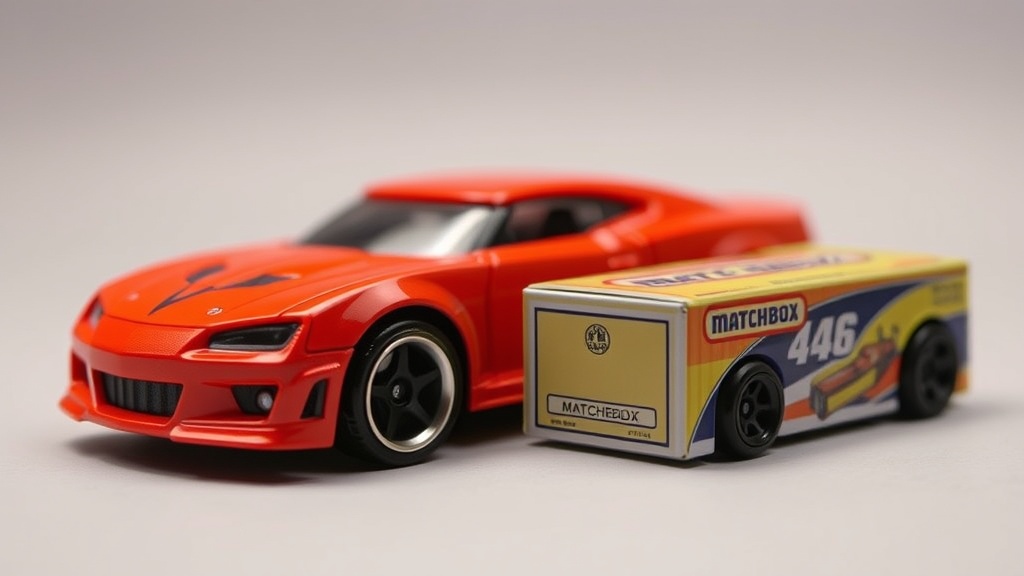
Hot Wheels and Matchbox are two titans of the miniature car world, each sparking joy and igniting imagination for generations of collectors and kids. Deciding between them, or understanding their nuanced differences, is a common quest for anyone looking to start a collection or simply buy a new toy car.
Key Takeaways
- Hot Wheels: Known for vibrant anachronistic designs, fantasy castings, speed, and track performance.
- Matchbox: Favors realistic, licensed vehicles with a focus on real-world utility and classic cars.
- Materials: Both brands use similar diecast metal and plastic construction, with Hot Wheels often having more elaborate plastic accessories.
- Collectibility: Both brands offer mainstream releases and highly sought-after collector editions, with varying rarity.
- Playability: Hot Wheels excels with elaborate track sets; Matchbox shines in imaginative, real-world scenario play.
The Enduring Rivalry: Hot Wheels vs. Matchbox
As a lifelong diecast enthusiast, the “Hot Wheels vs. Matchbox” debate is practically etched into my DNA. My earliest memories involve countless hours pushing these miniature marvels across carpet racetracks and elaborate dirt landscapes in the backyard. While both brands hold a cherished place in my heart, they truly are distinct, catering to different tastes and play styles.
Matchbox, with its origins in England, arrived first in 1953, pioneering the 1:64 scale (though scales varied a bit in the early years) and focusing on realistic, everyday vehicles. I remember the satisfying heft of those early Matchbox cars, often featuring opening doors or a moving shovel – little details that mirrored the real world.
Hot Wheels burst onto the scene in 1968, a bold American entry by Mattel, challenging the status quo with flashy “Redline” wheels and fantastical designs. I recall the sheer excitement of those first Hot Wheels sets, cars practically flying down orange tracks, defying gravity with loops and jumps. It was a revolution in play.
Over the decades, both brands have evolved significantly, expanding their lineups, experimenting with new features, and navigating the ebb and flow of market trends. Yet, their core identities, established in those formative years, largely remain.
Design Philosophy: Realism vs. Fantasy
Perhaps the most significant differentiator between Hot Wheels and Matchbox lies in their fundamental design philosophies.
Matchbox: The World in Miniature
Matchbox has always prided itself on realism. Their vehicles are predominantly licensed models of real-world cars, trucks, and utility vehicles. Think classic Ford Mustangs, rugged Jeep Wranglers, fire engines, police cars, and construction equipment. The details are often understated but accurate, with realistic paint schemes and tampo-printed headlights and taillights. Many older Matchbox models, and some newer ones, even feature opening parts like doors, hoods, or tailgates, adding to their tactile realism.
For me, Matchbox cars always felt like a miniature extension of the world outside my window. They were the cars my parents drove, the commercial vehicles I saw on the street, or the emergency responders that caught my eye. This focus on “real-world” designs makes them fantastic for imaginative play where kids can recreate everyday scenarios or invent their own grounded adventures. For collectors, the appeal often lies in acquiring accurate representations of iconic vehicles or complete sets of a particular marque.
Hot Wheels: Speed, Style, and Imagination Unbound
Hot Wheels, in stark contrast, is about pushing boundaries. While they certainly produce licensed, realistic cars (often sportier models like Ferraris, Lamborghinis, or classic muscle cars), a significant portion of their lineup consists of “fantasy castings” – original designs that defy gravity, logic, and often, real-world physics. These can range from sleek, futuristic speedsters to monster trucks, absurd contraptions, and even vehicles based on pop culture franchises.
Hot Wheels cars are designed for speed and performance on their iconic orange tracks. Their low-friction wheels and aerodynamic shapes are optimized for high-velocity stunts and races. The paint jobs are often vibrant, metallic, and eye-catching, designed to stand out. From a collector’s perspective, this means chasing rare color variations, popular fantasy castings, or limited-edition collaborations. For the younger me, Hot Wheels were pure exhilaration – the cars that felt fastest, looked coolest, and could do things no real car ever could.
Construction and Materials
Both Hot Wheels and Matchbox cars are primarily constructed using a “diecast” method, where molten metal (typically zinc alloy, often referred to as Zamak) is injected into molds to create the car’s body and chassis. Plastic components are then added for interiors, windows, and wheels.
- Body: Both brands use diecast metal for the main body shell, which gives them their characteristic weight and durability. I’ve dropped countless Hot Wheels and Matchbox cars over the years, and while paint chips are inevitable, the metal bodies are remarkably resilient.
- Chassis: Historically, Matchbox often featured diecast metal bases, contributing to their solid feel. Hot Wheels almost exclusively uses plastic bases, which is lighter and helps with speed on tracks. In recent years, both brands have incorporated more plastic into their chassis designs for cost and manufacturing efficiency, though premium collector lines from both may retain metal bases.
- Wheels: This is a crucial distinction. Matchbox wheels are generally more understated, featuring realistic hubcap designs and often hard plastic tires, though rubber tires appear on some premium lines. Hot Wheels wheels are iconic for their low-friction plastic, designed for speed and track performance. Early Hot Wheels are famous for their “Redline” wheels, which are highly sought after by collectors. Modern Hot Wheels wheels come in a vast array of styles, many with chrome-like finishes or intricate spokes, but always prioritizing speed.
- Interiors and Windows: Both brands use clear plastic for windows and molded plastic for interior details, though these are often simplified at the 1:64 scale. Hot Wheels sometimes features more aggressive, stylized interiors to match their fantasy designs.
- Paint and Decals: Both utilize durable paint finishes and tampo-printed decals for logos, headlights, and other graphics. Hot Wheels tends to favor more vibrant colors, metallic finishes, and bolder graphics, consistent with its flashy aesthetic. Matchbox colors are generally more subdued and true to real-world vehicle colors.
From personal experience, I’ve had paint peel or chip on both Hot Wheels and Matchbox over the decades, especially on well-loved play pieces. The quality seems comparable across their standard lines. For customizers, the metal bodies are a great canvas, though removing original paint without damaging the metal requires care (I actually ruined a few early custom attempts with harsh chemicals – lesson learned!).
Scale and Size
Both Hot Wheels and Matchbox predominantly produce vehicles in the “1:64 scale,” meaning the miniature car is 1/64th the size of its real-world counterpart. However, this is largely an approximate scale, especially with Hot Wheels’ diverse range of fantasy castings and Matchbox’s own variations.
What’s more important than exact mathematical scale is that they are designed to be compatible with each other. A Hot Wheels car and a Matchbox car will typically be roughly the same size, allowing them to be played with together or displayed side-by-side without looking out of place. Most track sets, especially those not brand-specific, will accommodate cars from both manufacturers.
Beyond the standard 1:64 scale, both brands also venture into other sizes for special releases:
- Larger Scales: You might find “Elite” or premium Hot Wheels in 1:43 or 1:18 scale, offering much greater detail and often commanded higher prices. Matchbox also has its share of larger models, often trucks.
- Playsets and Accessories: Both offer garage playsets, car carriers, and other accessories designed to complement their main line of vehicles.
Playability and Track Compatibility
This is where the differences often become most apparent, especially for kids.
Hot Wheels: The Track Master
Hot Wheels cars are engineered for speed and stunts. Their low-friction plastic wheels and often aerodynamic designs make them perfect for zooming down orange tracks, performing loops, jumps, and twists. Mattel has invested heavily in an extensive ecosystem of Hot Wheels tracks, launchers, and playsets that are all about action, speed, and competitive racing. If you’re buying for a child who loves speed, ramps, and elaborate setups, Hot Wheels is usually the go-to choice. I spent countless hours building intricate track layouts, trying to get my cars to make the craziest jumps – a testament to the brand’s primary focus.
Matchbox: Imaginative, Real-World Play
Matchbox cars, while perfectly capable of being pushed around, aren’t primarily designed for high-speed track performance. Their appeal lies more in imaginative, real-world play. Kids can use them to transport goods, respond to emergencies, build miniature cities, or recreate scenes from daily life. The realistic designs and utility vehicles naturally lend themselves to these types of scenarios. Many Matchbox playsets focus on garages, construction sites, or city environments rather than race tracks. For a child who enjoys storytelling and role-playing with their cars, Matchbox offers a rich canvas.
Collectibility and Value
Both Hot Wheels and Matchbox have incredibly passionate collector bases, and both offer significant collector value for certain models.
Hot Wheels Collectibility:
Hot Wheels collectibility is often driven by:
- “Treasure Hunts” and “Super Treasure Hunts”: These are rare, specially marked cars (green flame logo for regular, gold flame logo, Real Riders wheels, and Spectraflame paint for Super Treasure Hunts) hidden within regular assortments, making them highly sought after. Finding one in the wild is a true thrill!
- Redline Era Cars: Early Hot Wheels from 1968-1977 with red circles on the tires. These are iconic and can fetch high prices, especially in good condition.
- Error Cars: Vehicles with manufacturing defects (missing paint, wrong wheels, etc.) are sometimes considered desirable rarities.
- Specific Castings: Popular fantasy cars or licensed vehicles that are frequently released can also become collectible, especially first editions or rare color variations.
- Pop Culture / Premium Lines: Hot Wheels has extensive lines tied to movies, TV shows, and real car culture (e.g., Car Culture, Boulevard), often featuring more detail, metal bases, and Real Riders (rubber tires).
Matchbox Collectibility:
Matchbox collectibility is often driven by:
- “Lesney England” Era: Analogous to Hot Wheels Redlines, early Matchbox cars manufactured by Lesney in England (pre-1980s) are highly prized, particularly the “1-75 series.”
- Error Cars: Similar to Hot Wheels, manufacturing errors can create rare variants.
- Licensed Classics: Realistic models of classic or iconic vehicles are always popular.
- Special Editions: Matchbox sometimes releases “Superfast” (early low-friction wheels) or “Convoys” line items, or more recently, “Collector” series vehicles that feature rubber tires and higher detail.
- Code 2 / Promotional Models: Matchbox was famous for producing promotional vehicles for real companies, making these often rare and valuable.
As a collector, I find myself drawn to both, but for different reasons. Hot Wheels for the thrill of the hunt for a Treasure Hunt or a stunning premium line model, and Matchbox for the nostalgia of those early realistic castings or the satisfaction of completing a series of real-world vehicles. Condition is paramount for both, especially when it comes to original packaging.
Hot Wheels vs. Matchbox: A Quick Comparison
| Feature | Hot Wheels | Matchbox |
|---|---|---|
| Primary Focus | Speed, stunts, fantasy, racing, track play | Realism, utility, everyday vehicles, imaginative play |
| Design Style | Bold, flashy, futuristic, fantasy, pop culture | Realistic, authentic, classic, understated |
| Vehicle Types | Race cars, muscle cars, fantasy, sci-fi, concepts | Sedans, trucks, vans, emergency, construction, classics |
| Wheels | Low-friction plastic, colorful, diverse styles | Realistic hubcap designs, harder plastic, often simpler |
| Chassis | Predominantly plastic (standard mainline) | Often plastic, historically metal (Lesney/older) |
| Paint & Decals | Vibrant, metallic, aggressive graphics | Realistic colors, accurate liveries, subtle details |
| Track Play | Excellent, designed for speed, loops, jumps | Decent, but not optimized for high-speed stunts |
| Collector Appeal | Treasure Hunts, Redline, Error, Pop Culture, Premiums | Lesney England, Error, Licensed Classics, Superfast |
| Target Audience | Kids (5+) who love action, speed, and imagination | Kids (5+) who love realism, role-playing, and storytelling |
My Recommendation: Why Not Both?
So, which is better? As a diecast veteran, my answer is almost always: it depends on what you’re looking for, and often, the best answer is both.
If you’re buying for a child who is captivated by speed, wants cars to zoom down tracks, and loves flashy, imaginative designs, Hot Wheels is likely to be the instant hit. The sheer variety and play value of their track systems are unmatched.
If you’re looking for miniature versions of familiar cars, trucks, and utility vehicles that encourage realistic imaginative play, or if you appreciate accurate scale models, then Matchbox is an excellent choice. They often feel more grounded and substantial.
For collectors, both brands offer deep dives into automotive history and pop culture, with distinct collecting paths. I know my own collection is a healthy mix of both, each piece telling a different story or representing a different era of automotive design – or pure fantasy!
Ultimately, for the price of a standard mainline diecast car (usually just a few dollars), you can easily sample both. Let your own preferences, or those of the child you’re shopping for, be the guide. You might find, like me, that there’s room in your heart and on your display shelf for the best of both worlds.
FAQ
What are the main differences between Hot Wheels and Matchbox cars?
The primary differences boil down to design philosophy: Hot Wheels focuses on speed, fantasy castings, and track performance with flashy designs, while Matchbox emphasizes realistic, licensed vehicles, utility, and real-world imaginative play with more understated designs. Hot Wheels often has plastic bases and low-friction wheels for speed, whereas Matchbox historically featured metal bases and more realistic wheels.
Which brand is better for collecting?
Both brands offer significant collectibility. Hot Wheels collectors often seek out rare “Treasure Hunts,” “Redline” era cars, and pop culture premium lines. Matchbox collectors covet “Lesney England” era cars, early “Superfast” models, and accurate licensed classic vehicles. Your preference for realism versus fantasy and rarity will guide which brand might appeal more to your collecting style, but both have a vibrant secondary market.
Are Hot Wheels and Matchbox cars the same size?
Yes, Hot Wheels and Matchbox cars are generally produced in the approximate 1:64 scale and are designed to be compatible in size. This means they can be played with together, mixed in collections, and often fit on generic track sets without an issue, even if exact dimensions vary slightly between individual models.
Can Hot Wheels cars be used on Matchbox tracks, and vice versa?
While both brands’ cars are roughly the same size, Hot Wheels cars are specifically engineered for high-speed track performance, including loops and jumps, due to their low-friction wheels and aerodynamic designs. Matchbox cars can be used on tracks, but they typically won’t perform stunts as effectively as Hot Wheels cars. Many generic tracks will accommodate both, but for optimal performance on stunt-oriented tracks, Hot Wheels cars are usually preferred.
Featured products
- Hot Wheels Car Culture Premium 1:64 Scale Die-Cast Toy Porsche 993 GT2 with Real Riders Tires & Metal/Metal Body & Chassis, Modern Classics
- Hot Wheels Premium Collectible Toy, Car Culture 1:64 Scale 2026 Ferrari Testarossa, Real Riders Tires & Metal/Metal Body & Chassis, Modern Classics
- Hot Wheels Premium Car Culture 1:64 Scale Die-Cast Ferrari 499P Collectible Vehicle with Real Riders Tires & Metal/Metal Body & Chassis
- Hot Wheels Premium Car Culture Collectible Toy Car, 1:64 Scale Die-Cast Nissan Skyline R34 GTR, Timeless Icons Vehicle with Real Riders Tires
- Hot Wheels Gran Turismo Premium POP Culture 2022 Porsche 911 GT3 RS Diecast Car
- Matchbox Mattel 80Th Anniversary 4-Pack Of Die-Cast 1:64 Scale Toy Cars & Trucks With Moving Parts
- Matchbox Collectors Series Die-Cast Cars, 1969 Audi 100, 1980 Mercedes-Benz, BMW M5, Classic Models, Bundle of 5, Ages 3+ GBJ48-965Y
- Matchbox Set of 15 Toy Cars and Trucks with 3 Themed 5-Packs of 1:64 Scale Die-Cast Vehicles (Styles Will Vary) Bundle
- Matchbox 8-Pack Die-Cast Vehicles with 1 Exclusive (Styles May Vary)