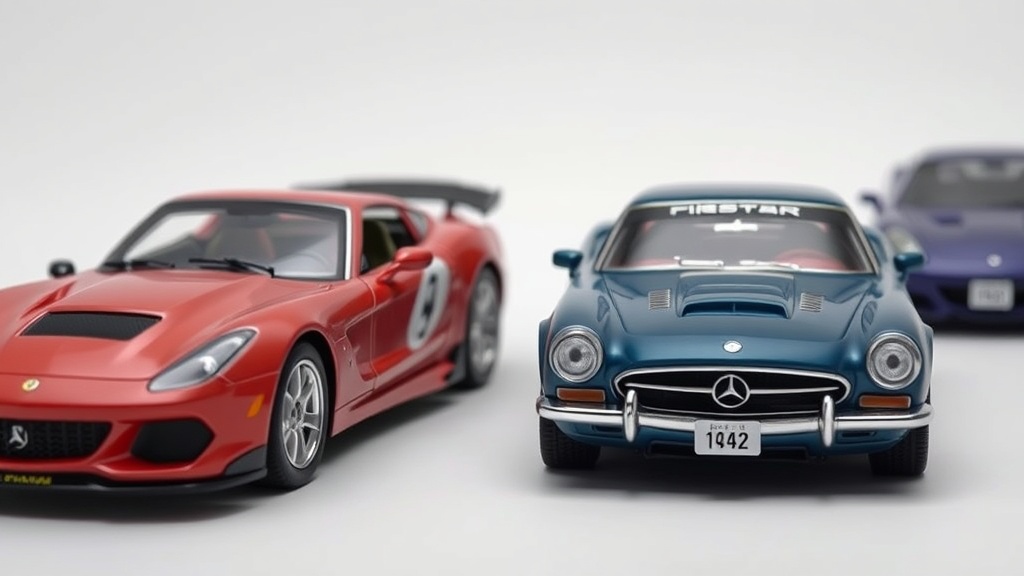
When it comes to collecting diecast cars, one of the first decisions you’ll face — and keep revisiting — is about scale. The choice between 1/18 vs 1/24 scale model cars is a common dilemma, each offering distinct advantages depending on your space, budget, and display preferences.
Key Takeaways
- 1/18 scale offers superior detail, opening parts, and a more imposing presence but comes with a higher price tag and demands significant display space.
- 1/24 scale provides a great balance of detail and affordability, making it ideal for larger collections, smaller spaces, and as an entry point for new collectors.
- Consider your display space carefully; 1/18 models can quickly overwhelm a shelf, while 1/24 models are more stackable and versatile.
- Budget often dictates scale; you can acquire many more 1/24 models for the price of a single high-end 1/18 piece.
- Brand matters: Some manufacturers specialize in one scale, offering consistently higher quality there. Look at brands like Autoart or BBR for 1/18, and Maisto or Bburago for quality 1/24.
Understanding Diecast Scales: What Do the Numbers Mean?
Before we dive into the pros and cons, let’s briefly clarify what “scale” actually means in the world of diecast. When you see a car advertised as “1/18 scale,” it means the model is 1/18th the size of the real, full-sized vehicle. So, if a real car is 18 feet long, the 1/18 scale model would be 1 foot long. Similarly, a 1/24 scale model would be 1/24th the size, making it smaller than its 1/18 counterpart. The larger the second number in the ratio, the smaller the model.
This might seem obvious to seasoned collectors, but I vividly remember when I first started, scratching my head trying to figure out why a larger second number meant a smaller car. It’s counter-intuitive until you internalize the fraction. The key takeaway is: 1/18 scale models are significantly larger and often more detailed than 1/24 scale models.
The Grand Presence of 1/18 Scale Diecast Cars
Ah, 1/18. This is where many serious collectors often gravitate for their showpiece models. I’ll admit, my first truly “special” diecast — a highly detailed Ferrari 250 GTO — was 1/18 scale, and it absolutely commanded attention on my shelf.
Pros of 1/18 Scale
- Exceptional Detail: This is the undisputed champion of 1/18. The larger size allows manufacturers to incorporate an incredible level of fidelity. We’re talking intricate engine bay wiring, fully carpeted interiors, detailed dashboard gauges, operable suspension, functional steering, and even tiny seatbelts. Brands like Autoart and BBR push the boundaries here, often using hundreds of individual parts to replicate every nuance of the real car. When you pick up a high-quality 1/18 model, it feels like a miniature car, not just a toy.
- Opening Parts: Most 1/18 models feature opening doors, hood, and trunk. This isn’t just a gimmick; it allows you to explore the interior, engine compartment, and trunk space, adding to the realism and interactive experience. I’ve spent countless hours examining the tiny V12 in my Autoart Lamborghini Countach.
- Impressive Presence: There’s no denying that a 1/18 model makes a statement. Placed on a desk or a prominent shelf, it naturally becomes a focal point. For collectors who want only a few, highly prized models, 1/18 scale delivers that “wow” factor.
- Strong Resale Value (for high-end models): Limited edition and highly detailed 1/18 models from premium brands often hold or increase their value over time, especially if kept in pristine condition with original packaging. This isn’t a guarantee for all models, but it’s more common in this scale than in 1/24.
Cons of 1/18 Scale
- Space Hogs: This is the biggest drawback for me, personally, as my collection grew. A single 1/18 model can measure anywhere from 9 to 12 inches long. A row of five of these can easily fill a 5-foot shelf. If you have limited display space, you’ll quickly run out of room. When I built my custom garage-style display walls, I had to ensure shelves were deep enough and spaced far enough apart to accommodate these giants.
- Higher Cost: Quality 1/18 models are significantly more expensive. While you can find budget options from brands like Maisto and Bburago for around $40-$70, truly premium 1/18 models from Autoart, Kyosho, or CMC can easily range from $200 to $1,000+, and even higher for rare vintage pieces. This can severely limit the size of your collection.
- Weight and Fragility: Due to their size and the complexity of their moving parts, 1/18 models can be quite heavy and sometimes more delicate. Those tiny hinges and intricate attachments require careful handling. I learned this the hard way when a less-than-gentle dusting session dislodged a tiny headlight from a particularly detailed model.
- Limited Variety in Some Niche Markets: While popular cars are well-represented, if you’re looking for extremely obscure models or vehicles from less popular eras, you might find more options in smaller scales or specialized model kits.
The Versatility and Value of 1/24 Scale Diecast Cars
1/24 scale is often seen as the workhorse of the diecast world. It’s where many collectors start, and it’s a size that offers an excellent balance between detail, affordability, and display footprint.
Pros of 1/24 Scale
- Excellent Balance of Detail and Size: While not as hyper-detailed as premium 1/18 models, good 1/24 scale cars still boast impressive features. You’ll often find opening doors and hoods (though trunks are less common), detailed interiors (minus the carpeting), and decent engine bay replication. For their size, they pack a punch. Brands like Maisto, Bburago, and Jada Toys offer fantastic value in this scale.
- Space Efficiency: This is where 1/24 truly shines for collectors with growing armies of cars. A 1/24 model is typically about 7 to 8 inches long, making it much easier to display a larger collection in the same amount of space. You can often fit two 1/24 models side-by-side where only one 1/18 would go. This is a huge advantage for creating themed displays or showcasing a comprehensive collection of a specific manufacturer or era.
- Affordability: Generally speaking, 1/24 models are significantly more affordable than their 1/18 counterparts. You can often pick up a decent 1/24 model for $15-$40. This makes it easier to build a substantial collection without breaking the bank. It’s also a great entry point for younger collectors or those new to the hobby. My kids started with 1/24 scale muscle cars, and it was a perfect way for them to develop an appreciation without fear of high-cost damage.
- Abundant Variety: This scale is incredibly popular, which means manufacturers produce a vast array of vehicles. From classic muscle cars to modern supercars, everyday sedans, and even movie cars, you’ll find a massive selection in 1/24. This makes it easier to find specific models you’re looking for.
- Ideal for Dioramas and Customization: The more manageable size of 1/24 models makes them very popular for dioramas, especially military and automotive scenes, or for customizers who want to modify and repaint models.
Cons of 1/24 Scale
- Less Intricate Detail: While good, the detail level in 1/24 models is naturally limited by the smaller size. You might miss out on fully wired engines, working suspensions, or carpeted interiors found in high-end 1/18 models. For static display, this might not be an issue, but for up-close examination, the difference is noticeable.
- Fewer Opening Parts (sometimes): While most 1/24 models have opening doors, opening hoods can be less common, and opening trunks are quite rare. This limits the “interactive” aspect compared to 1/18.
- Lower Perceived “Premium” Feel: While there are high-quality 1/24 models, the scale is often associated with more budget-friendly or “toy-grade” diecast, especially by non-collectors. This is often an unfair generalization as brands like Franklin Mint and Danbury Mint produced exceptionally detailed 1/24 models in the past, and companies like Jada Toys continue to impress with their attention to detail at their price point.
- Limited Resale Value: Unless it’s a very rare or highly sought-after vintage piece, most 1/24 models don’t appreciate significantly in value compared to their 1/18 counterparts. They are primarily collected for enjoyment rather than investment.
1/18 vs 1/24 Scale: At a Glance
Here’s a quick comparison to help you decide which scale might be right for your collection:
| Feature | 1/18 Scale | 1/24 Scale |
|---|---|---|
| Average Length | 9-12 inches (23-30 cm) | 7-8 inches (18-20 cm) |
| Detail Level | Exceptional, high fidelity (wiring, carpeting) | Very good, balanced detail |
| Opening Parts | Doors, hood, trunk, sometimes suspension | Doors, often hood; trunk less common |
| Presence | Commanding, showpiece | Solid, versatile display |
| Price Range | $40 - $1000+ (budget to premium) | $15 - $70 (entry-level to mid-range) |
| Space Needs | High; takes up significant shelf/display room | Moderate; allows for larger collections |
| Variety | Good for popular cars; some niche gaps | Vast; covers a wide range of vehicles |
| Ideal For | Showcase models, detailed displays, fewer cars | Large collections, limited space, budget-conscious |
| Brands | Autoart, Kyosho, CMC, BBR, Norev, Maisto, Bburago | Maisto, Bburago, Jada Toys, Welly, Greenlight |
Making Your Choice: What Matters Most to You?
The “best” scale truly depends on your individual priorities as a collector. I’ve collected both, and my emphasis has shifted over the years.
- If you prioritize ultimate detail and realism: And you have the budget and display space, then 1/18 scale is likely your preference. These models are masterpieces in miniature.
- If you want a large, diverse collection: And display space or budget are considerations, then 1/24 scale offers the best bang for your buck and space efficiency. You can enjoy a wide array of cars without feeling cramped.
- If you’re starting out: 1/24 scale is an excellent entry point. It’s affordable, widely available, and still offers satisfying detail. You can experiment with different car types and brands without a huge investment.
- If you enjoy dioramas or customization: The 1/24 scale is often favored for its manageable size and broad aftermarket support.
- If you are buying for a gift: A single, impressive 1/18 model can be a showstopper gift, while a few 1/24 models might allow for a small starter collection.
Personally, I’ve found a way to appreciate both. My most cherished models (often high-detail supercars or iconic classics) are 1/18 and reside in their own dedicated display cases. The bulk of my collection, encompassing various themes and eras, is 1/24, allowing for a much broader representation and easier display in my custom shelving units.
Don’t feel pressured to pick just one. Many collectors, like myself, have mixed collections. As long as you understand the tradeoffs, you can make informed decisions that suit your collecting style and circumstances. The most important thing is to enjoy the cars!
FAQ
What is the most popular scale for diecast cars?
Globally, 1/64 scale (Hot Wheels, Matchbox) is arguably the most popular due to its affordability and widespread availability. However, for larger, more detailed collector models, both 1/18 scale and 1/24 scale are extremely popular, with 1/24 often being favored for its balance of detail and collection size potential, while 1/18 is preferred by those seeking maximum realism and display presence.
Which brands make the best 1/18 scale diecast cars?
For exceptional detail and quality in 1/18 scale, look for brands like Autoart, Kyosho, BBR, and CMC. These manufacturers often use hundreds of parts and premium materials to create incredibly accurate replicas. For more budget-friendly but still good quality 1/18 models, Maisto and Bburago are excellent choices.
Is 1/24 scale good for collecting?
Absolutely! 1/24 scale is fantastic for collecting. It offers a great balance of detail, affordability, and space efficiency, allowing collectors to amass a diverse range of models without requiring vast amounts of display space or a huge budget. It’s an ideal scale for both new and experienced collectors.
Can I mix 1/18 and 1/24 scale models in my display?
Yes, you can certainly mix 1/18 and 1/24 models, but be mindful of the significant size difference. Placing them side-by-side might make the 1/24 models appear much smaller than they are, sometimes diminishing their individual impact. I often display them on separate shelves or in distinct themed sections to maintain visual coherence. For example, all my 1/18 Ferraris are together, and my 1/24 muscle cars have their own dedicated space.
Are 1/18 scale models worth the higher price?
For many collectors, yes, 1/18 scale models are worth the higher price due to their unparalleled detail, opening parts, and commanding presence. If you prioritize realism, intricate features, and owning fewer, highly impressive display pieces, the investment in a quality 1/18 model is often justified. However, if budget or space are primary concerns, the value proposition shifts, making 1/24 or smaller scales more appealing.