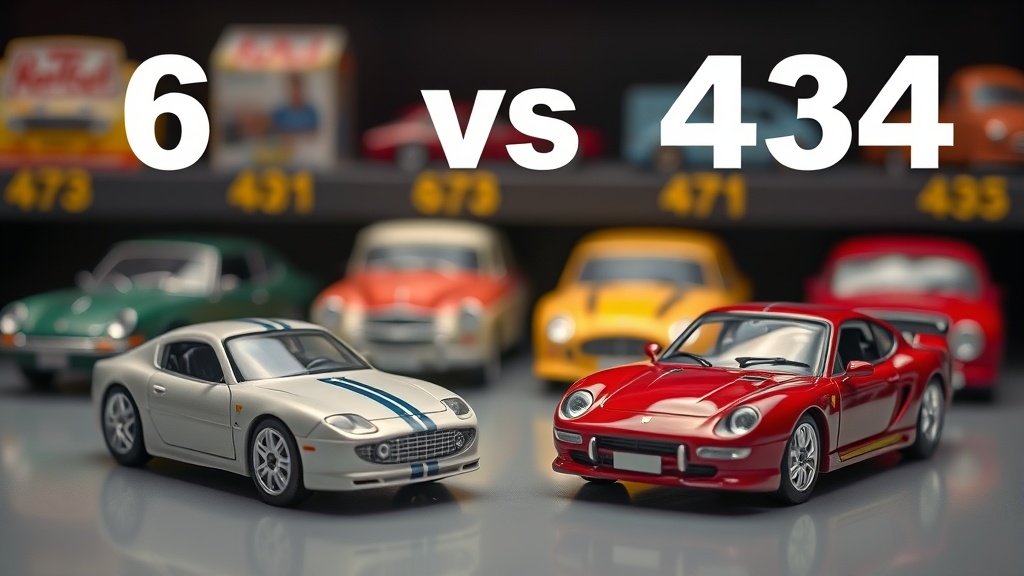
Collecting diecast model cars is a hobby that offers endless possibilities, and understanding the nuances of different scales is key to building a collection you’ll love. Today, we’re diving into two of the most popular smaller scales: 1/64 vs 1/43 scale model cars, to help you decide which is right for your collection and display space.
Key Takeaways
- 1/64 scale models are typically 2.5 to 3 inches long, offering a vast selection, affordability, and easy display in large quantities, making them ideal for dioramas and play.
- 1/43 scale models are generally 4 to 5 inches long, providing a higher level of detail, greater realism, and a strong collecting community, appealing to display-focused enthusiasts.
- Display space is a major factor; 1/64 allows for more models in a smaller footprint, while 1/43 demands more room but offers a grander presence.
- Cost per model is significantly lower for 1/64, while 1/43 models often represent a greater investment due to their enhanced detail and sometimes limited production runs.
- The “best” scale depends entirely on your personal priorities: budget, space, desired detail, and collection goals.
The World of Small Scales: 1/64 and 1/43 Explained
When I first started collecting diecast, I was like a kid in a candy store, grabbing anything that looked cool. It didn’t take long to realize that scale was a critical factor, not just for consistency, but for how I could actually display my growing collection. For many collectors, especially those starting out or with limited space, the smaller scales like 1/64 and 1/43 are incredibly appealing.
Let’s break down what these numbers mean. A scale of 1/64 means the model is 1/64th the size of the actual car. So, if a real car is 160 inches long, a 1/64 scale model would be 2.5 inches. Similarly, a 1/43 scale model is 1/43rd the size of the real car. That same 160-inch car would be approximately 3.72 inches at 1/43 scale. It’s a simple concept, but the implications for collecting are huge.
The Everyday Hero: 1/64 Scale Model Cars
When most people think of small diecast cars, they’re probably picturing a 1/64 scale model. This is the realm of Hot Wheels, Matchbox, and countless other brands that have captivated generations. These models are typically around 2.5 to 3 inches long, making them perfectly palm-sized.
I’ve been collecting 1/64 scale for decades. My first Hot Wheels redline was a Custom Mustang my uncle gave me. The sheer variety and affordability of 1/64 scale models are unmatched. You can walk into almost any big box store and find new releases, from exotic supercars to classic muscle cars and even everyday vehicles. This accessibility means you can quickly build a diverse collection without breaking the bank.
Pros of 1/64 Scale:
- Affordability: Generally the most budget-friendly option. This was huge for me when I was younger and even now, it allows me to grab half a dozen models for the price of one larger scale car.
- Vast Selection: The market is flooded with choices from numerous manufacturers.
- Space-Saving: You can fit an incredible number of these models into a display case or onto a shelf. Perfect for building intricate dioramas.
- Play Value: Durable enough for kids’ play (though serious collectors handle them with care).
- Community: A massive and active community of collectors, traders, and customizers.
Cons of 1/64 Scale:
- Limited Detail: While modern 1/64 models from brands like Mini GT or Tarmac Works are astounding in their detail, many entry-level models have painted lights and simplified interiors.
- Less Presence: Individually, they don’t command the same visual presence as larger models.
- Consistency: Sizing can vary slightly between manufacturers even within the 1/64 scale, which can be noticeable if you’re a stickler for uniform display.
Brands like Hot Wheels, Matchbox, GreenLight, Auto World, M2 Machines, Johnny Lightning, Tomica Limited Vintage, Mini GT, and Tarmac Works are all prominent in the 1/64 scale. Each offers a slightly different level of detail and price point, allowing collectors to find their niche. For example, while Hot Wheels are king for fantasy castings and speed, Tomica Limited Vintage offers incredible realism and intricate details at a higher price for 1/64.
The Detailed Workhorse: 1/43 Scale Model Cars
Stepping up a notch in size and often in detail, we find the 1/43 scale. These models typically measure around 4 to 5 inches long. This scale often strikes a fantastic balance between manageable size and impressive detail, appealing to collectors who want something more substantial than 1/64 but don’t have the space for 1/18 or larger.
When I started getting serious about specific marques, like Ferrari, I found myself gravitating towards 1/43. The ability to see fine details like brake calipers, engine bay elements (on some models), and more intricate interior features became a draw. These aren’t just toys; they’re miniature representations designed for display.
Pros of 1/43 Scale:
- Enhanced Detail: Significantly more intricate than most 1/64 models, often featuring separate clear plastic headlamps, detailed grilles, realistic interiors, and sometimes even opening parts (though less common than in 1/18).
- Strong Presence: They stand out individually on a shelf or in a display case.
- Specialized Models: Many niche manufacturers produce rare or esoteric vehicles exclusively in 1/43 scale.
- Historical Significance: Many classic racing car models are widely available in this scale.
Cons of 1/43 Scale:
- Higher Cost: Generally more expensive than 1/64 models, sometimes significantly so, especially for resin or hand-built pieces.
- More Space Required: While smaller than 1/18, they take up noticeably more room than 1/64, limiting the number you can display in a given area.
- Fragility: Often more delicate due to finer details and materials, making them less suitable for active play.
Bburago, norev, Minichamps, Spark, IXO Models, AutoArt, and Kyosho are just a few of the prolific brands in the 1/43 scale. You’ll find a wide range of pricing and detail levels here, from entry-level Bburago to highly detailed resin models from Spark that can cost upwards of $100 or more for a single model. Many formula 1 and endurance racing cars are produced in this scale, allowing for incredible collections of specific race liveries.
The Great Showdown: 1/64 vs 1/43
This isn’t about which scale is “better”—it’s about which scale is better for you. It took me years to truly understand my own collecting habits and what brought me the most joy. My advice? Don’t feel pressured to pick just one, but understand the implications of each.
Display Space: The Ultimate Constraint
This is often the deciding factor for many collectors, and it certainly was for me as my collection grew. I remember hitting a wall where my shelves were overflowing with 1/64, and I realized I wanted something with more ‘oomph’ for some of my favorites, leading me to 1/43, and eventually, 1/18.
- 1/64 scale: Imagine a standard 2-foot wide shelf. You could easily line up 8-10 cars side-by-side, or even more if you stack them creatively in display cases like the Carney Plastics display cases or a simple tiered acrylic stand. Dioramas thrive in this scale because you can populate them with many vehicles and figures without needing an entire room.
- 1/43 scale: On that same 2-foot shelf, you’re more likely to fit 5-6 cars comfortably. Each model needs a bit more breathing room to show off its details. While dioramas are possible, they become much larger productions to accommodate the vehicles.
If you have a dedicated “man cave” or a large display area, space might not be an issue. But for most of us, who are integrating our hobby into shared living spaces, every inch counts.
Detail and Realism: Seeing the Finer Points
This is where 1/43 scale often shines, though 1/64 has made significant strides thanks to brands like Mini GT.
- 1/64 scale: Entry-level models typically have molded-in details, painted lights, and basic interiors. Higher-end 1/64 models, however, can feature separate plastic light lenses, rubber tires, detailed wheel designs, intricate tampos (decals), and even some interior color variations. Some customizers can take these models to unbelievable levels of detail.
- 1/43 scale: Expect separate head and taillight lenses, often featuring texture or clear plastic for realism. Chrome trim is usually separate pieces, grilles are often photo-etched, and interiors are more comprehensively modeled with distinct seats, dashboards, and steering wheels. On some models, you’ll even find textured floor mats or miniature seatbelts. The craftsmanship is generally a step up.
For me, the joy of a good 1/43 model is in admiring the subtle curves, the fine badging, and the way the light catches the metallic paint. You just can’t get that same level of immersion from most 1/64 models, no matter how good they are.
Price Point: Your Budget’s Best Friend
This is usually the deal-breaker or deal-maker for new collectors.
- 1/64 scale: You can famously snag a Hot Wheels mainline for a dollar or two. Even premium Hot Wheels or Matchbox are usually under $10. Higher-end collector brands like Mini GT or Tomica Limited Vintage can range from $15 to $30 or more, but that’s still significantly less than a comparable 1/43. This makes it easy to experiment and acquire many models.
- 1/43 scale: Entry-level brands like Bburago might start around $15-25. However, standard collector brands like norev or IXO Models are typically in the $40-60 range. Premium brands like Minichamps or Spark can easily hit $70-120 and beyond for limited editions or resin models. Your dollar won’t go as far, but each purchase feels more significant.
My personal strategy has been to collect a vast quantity of affordable 1/64 for general interest and fun, and then invest in select 1/43 (or 1/18) models for cars that hold particular significance to me, like my dream Ferrari F40.
Collectibility and Rarity
Both scales offer incredible avenues for collecting, but the rarity and collector value can differ.
- 1/64 scale: Rare Hot Wheels often command astonishing prices, largely due to variations, limited runs (like chase cars), and the sheer volume of collectors. The “holy grail” of 1/64, the rear-loading Volkswagen Beach Bomb, is rumored to fetch six figures. While most common models won’t appreciate much, specific releases, factory errors, or early castings can become very valuable.
- 1/43 scale: Many 1/43 models are produced in more limited quantities, particularly those from specialized brands or resin manufacturers. This inherent scarcity can lead to higher prices on the secondary market for out-of-production models. The historical focus of many 1/43 brands also means models of classic race cars or obscure vehicles can be highly sought after by dedicated collectors.
I’ve found it’s easier to stumble upon a valuable 1/64 in the wild (if you know what to look for!), whereas valuable 1/43 models are typically known entities and require more intentional searching.
Choosing Your Scale: A Comparative Approach
To help you decide, here’s a quick comparison of key factors:
| Feature | 1/64 Scale | 1/43 Scale |
|---|---|---|
| Typical Length | 2.5 - 3 inches (6.35 - 7.62 cm) | 4 - 5 inches (10.16 - 12.7 cm) |
| Average Cost | $1 - $30 (entry to high-end collector) | $15 - $150+ (entry to high-end resin) |
| Detail Level | Basic to highly detailed, depending on brand | Good to excellent, significant presence of separate parts |
| Opening Parts | Rare, mostly on higher-end collector brands | Occasional, usually doors or hoods, less common than 1/18 |
| Typical Materials | Diecast metal body, plastic chassis, plastic wheels | Diecast metal or resin body, plastic/metal details, rubber/plastic tires |
| Display Space | Very efficient, allows for large collections/dioramas | Requires more space, individual models stand out more |
| Manufacturer Variety | Extremely high, mass market to niche collector | High, strong presence of specialized niche manufacturers |
| Community Focus | Mass market, customizers, treasure hunting | Niche collectors, specific marques, historical replicas |
| Play Value | High (Hot Wheels, Matchbox) | Low, primarily for display |
Beyond the Numbers: My Personal Experience
My collection is a mix, which I think is a path many collectors eventually take. I have walls of Hot Wheels 1/64 models, neatly categorized, representing years of joyful “treasure hunting” at local stores. They’re fantastic for building large-scale automotive landscapes or just admiring the sheer variety of designs.
But then, nestled in more protected display cases, are my prized 1/43 and 1/18 cars – often limited edition Ferraris, classic Porsche 911s, or specific racing legends. These are the models I spend more time admiring for their intricate details, the models that remind me why I fell in love with cars in the first place.
Building display walls, as I’ve documented on this site, is often a response to an overflowing collection. If you’re starting small and want to grow fast, 1/64 is the undisputed champion. If you’re after a handful of meticulously crafted gems that make a statement, 1/43 offers that beautiful blend of detail and manageable size. And if you’re like me, you’ll find a way to enjoy the best of both worlds.
Ultimately, the choice comes down to your priorities as a collector. How much detail do you crave? How much space do you have? And how much are you willing to spend? There’s no wrong answer, only the right answer for your collection. Enjoy the hunt!
FAQ
What are the main differences between 1/64 and 1/43 scale model cars?
The primary differences lie in size, detail, and price. 1/64 scale models are smaller (around 2.5-3 inches), generally more affordable, and offer a basic to good level of detail. 1/43 scale models are larger (around 4-5 inches), typically more expensive, and boast a significantly higher level of intricate detail and realism due to their increased size allowing for finer craftsmanship. If you’re still weighing your options, our guide to which model car scale is best covers the full range from 1/64 up to 1/18.
Which scale is better for collecting many models on a budget?
For collecting a large quantity of models on a budget, 1/64 scale is definitively better. Mass-market brands like Hot Wheels and Matchbox are widely available and very affordable, making it easy to amass a diverse collection without significant financial outlay. If you’re looking to buy a couple of hundred cars, 1/64 scale makes that a realistic goal — see our picks for the best 1/64 scale diecast cars to start building a list.
Do 1/43 scale models have opening doors or hoods?
Some 1/43 scale models do feature opening parts like doors, hoods, or trunks, but it is less common than in larger scales like 1/18. Often, these features are found on models produced by brands that focus on higher detail or specific vehicle types. Many premium 1/43 models, especially those made from resin, are fully sealed to maximize body fidelity and detail. Browse our best 1/43 scale model cars roundup for examples of both approaches.
Can 1/64 scale models be as detailed as 1/43 scale?
While historically 1/43 scale offered superior detail, modern advancements in 1/64 scale model manufacturing have significantly narrowed the gap. High-end 1/64 brands like Mini GT and Tomica Limited Vintage produce models with impressive levels of detail, including separate clear light lenses, rubber tires, and intricate tampo work. However, the larger canvas of 1/43 scale still generally allows for more minute visual details and components to be replicated.