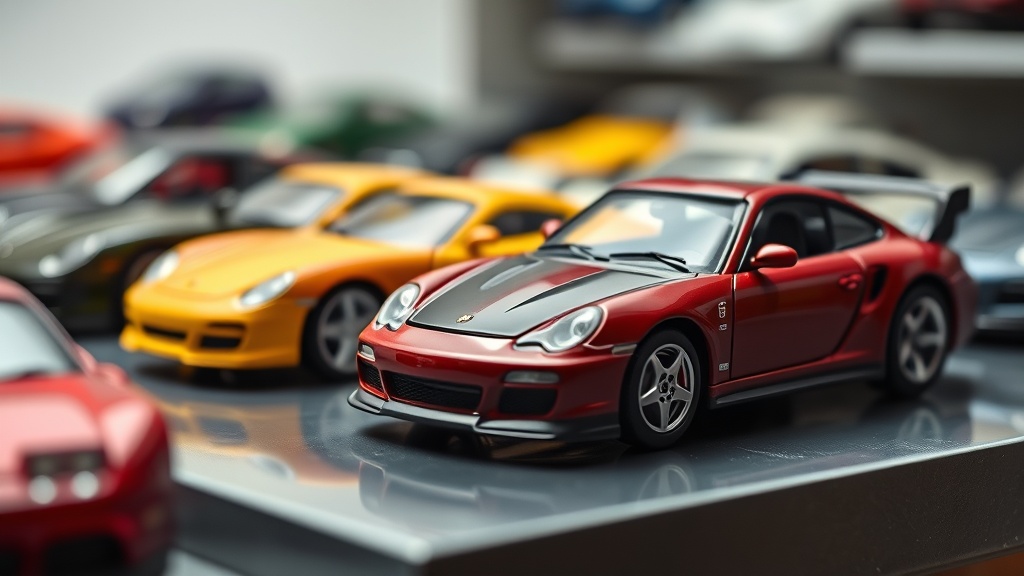
Embarking on the journey of model car collecting can be an incredibly rewarding hobby, offering a tangible connection to automotive history and personal passions. As someone who’s spent decades building, displaying, and occasionally cringing at early mistakes (like that one time I used an industrial cleaning solvent on a vintage paint job – oops!), I’m here to guide you through the exciting world of acquiring these miniature marvels.
Key Takeaways
- Start with your passion: Collect what truly interests you, whether it’s a specific car make, era, or racing series. This makes the hobby sustainable and enjoyable.
- Scale matters: Understand the common scales (1/64, 1/43, 1/24, 1/18) and choose what fits your space and budget.
- Quality over quantity: A few well-chosen, high-quality models often bring more satisfaction than a large collection of inexpensive ones.
- Display and care are crucial: Proper display cases and gentle cleaning preserve your models and enhance their visual appeal.
- Connect with the community: Online forums, local clubs, and shows are fantastic resources for learning, buying, and selling.
Why Collect Model Cars?
For many, myself included, model car collecting isn’t just about owning miniature vehicles; it’s about preserving history, admiring engineering, and connecting with a personal love for automobiles. My own collection started with Hot Wheels cars as a kid, evolving into a fascination with 1/18 scale Ferraris and classic American muscle cars as I got older. Each model tells a story, whether it’s celebrating a legendary race car, a groundbreaking design, or a personal dream car. It’s a hobby that engages both the mind and the eye, offering endless opportunities for research, display, and even light restoration.
Beyond the aesthetics, collecting can be a relaxing and meditative activity. Poring over the finely detailed interior of a Autoart 1/18 scale model, or admiring the authentic engine bay of a Kyosho replica, provides a quiet satisfaction. It’s a way to own a piece of automotive perfection, even if the real thing is utterly unobtainable. And for parents, it’s a fantastic way to share your passion with children, teaching them about different eras of cars, the mechanics behind them, and the joy of careful stewardship.
Understanding Scales: Finding Your Niche
One of the first decisions you’ll face as a new collector is choosing a scale. This dictates the size of your models and, consequently, your display options and budget. I’ve collected across many scales over the years, and each has its unique advantages.
1/64 Scale: The Pocket Rockets
Think Hot Wheels and Matchbox cars. These are the entry point for most collectors, offering incredible variety at an affordable price. They’re small, typically 2.5-3 inches long, making them easy to store and display in large numbers. While often seen as toys, many brands like Hot Wheels Redline, Matchbox Superfast, Greenlight, and Mini GT produce highly detailed collector-focused 1/64 models. I still have some of my original Redlines, carefully preserved, which now fetch a surprising price! This scale is perfect for dioramas or for those with limited space.
1/43 Scale: The European Standard
Popular in Europe, 1/43 scale models (around 4-5 inches long) strike a balance between small size and greater detail than 1/64. Brands like Spark, Minichamps, and IXO Models offer an extensive range, particularly of classic cars, F1 racers, and European sports cars. Many premium resin models are also produced in this scale. If you’re keen on collecting a wide variety of specific, often obscure, race cars or concepts, 1/43 is a fantastic choice, though they can be pricier than 1/64 diecast.
1/24 Scale: The Classic Kit Builder
Larger than 1/43, at about 6-8 inches long, 1/24 scale is very popular for plastic model kits from companies like Tamiya and Revell. Diecast offerings are also available, often found in retail stores like Walmart or Target, from brands like Maisto and Bburago. This scale offers a good compromise for detail without being overly large, making it a great starting point for those who might eventually want to build model kits. I built countless Tamiya kits in this scale in my younger days, and the satisfaction of seeing a meticulously painted and assembled model is unparalleled.
1/18 Scale: The Collector’s Darling
This is arguably the most popular scale for serious diecast collectors, myself included. Models typically range from 9-12 inches long, offering an incredible level of detail. You can often open doors, bonnets, and boots to reveal intricate interiors, engine bays, and chassis components. Brands like Autoart, Kyosho, Norev, Solido, Bburago, and Maisto dominate this market. While Autoart is synonymous with exquisite (and expensive) detail, Bburago and Maisto offer excellent value for money, providing impressive replicas at a more accessible price point. Many of my display cases are filled with 1/18 scale models because they strike the perfect balance between presence and detail.
Larger Scales (1/12, 1/8): The Grand Statements
For those with ample space and budget, 1/12 and even 1/8 scale models are true showstoppers. These colossal replicas offer unparalleled detail, right down to working suspensions and fully wired engines. Brands like Amalgam Collection produce breathtaking (and bank-breaking) 1/8 scale models, often costing thousands of dollars. While not for every beginner, these scales represent the pinnacle of model car artistry.
Diecast vs. Resin vs. Plastic Kits
Understanding the material your model is made from is crucial, as it impacts cost, detail, and durability.
- Diecast Metal: This is what most people think of when they hear “model car.” Molten zinc alloy is injected into a mold, creating a durable and weighty model. Diecast models often feature opening parts, steering, and rolling wheels. Brands like Autoart, Kyosho, Norev, Maisto, and Bburago produce excellent diecast models. They are generally robust and can withstand some handling, though delicate parts can still break.
- Resin Models: Made from cast resin, these models offer incredibly sharp details and complex shapes that can be difficult to achieve with diecast. They are usually “sealed,” meaning doors and bonnets don’t open. This allows for cleaner body lines and avoids the panel gaps inherent in diecast opening parts. Spark and BBR are prominent resin manufacturers. Resin models are typically more expensive and much more fragile than diecast, making them better suited for static display. I’ve broken a few mirrors on resin models just by looking at them wrong – handle with extreme care!
- Plastic Model Kits: These come unassembled and unpainted, usually made from polystyrene plastic. Brands like Tamiya, Revell, and Fujimi are kings here. Building kits offers a hands-on experience, allowing you to customize paint, add detail, and learn about the internal workings of a car. It requires patience, tools, and a steady hand, but the satisfaction of completing a kit is immense. This is how I learned a lot about car design and construction at a young age.
Where to Buy Your Models
The hunting is almost as much fun as the owning! Your purchasing options will vary depending on the scale and type of model you’re looking for.
- Online Retailers: This is the most common avenue for serious collectors. Dedicated diecast shops offer vast selections, often with pre-order options for upcoming releases. Search for reputable hobby shops that specialize in model cars.
- eBay and Auction Sites: A treasure trove for both new and vintage models, but exercise caution. Always check seller ratings, ask for detailed photos, and understand shipping costs. You can find some amazing deals, but also be wary of fakes or models with hidden damage. I’ve scored some fantastic vintage Hot Wheels Redlines this way, but also received a few duds that ended up as “parts cars.”
- Hobby Shops: Local hobby shops are invaluable resources, offering not just models but also advice, tools, and community. Support them if you have one nearby! They are especially good for plastic model kits and accessories.
- Toy Stores/Discount Retailers: For 1/64 and some 1/24 scale models (e.g., Hot Wheels, Matchbox, Maisto, Bburago), major retailers are your go-to. Keep an eye out for rare “chase” cars or special editions.
- Model Car Shows & Swap Meets: These events are fantastic for connecting with other collectors, finding rare models, and sometimes getting better prices than online. It’s also a great way to see models up close before buying.
Essential Care and Display Tips
Once you’ve started your collection, protecting and displaying your models is crucial.
- Dust is the Enemy: Dust can scratch paint, get into crevices, and generally degrade your model’s appearance over time.
- Display Cases: For 1/18 and 1/24 scale models, individual acrylic display cases are highly recommended. They protect against dust and accidental bumps. For smaller scales, sealed multi-car display cases are great.
- Regular Cleaning: For models not in cases, a soft makeup brush or a can of compressed air is ideal for dusting. Never use harsh chemicals or abrasive cloths. For fingerprints, a very slightly damp microfiber cloth can work, but test in an inconspicuous area first. I learned this the hard way with a vintage Dinky Toy that now has a slightly dull patch on its boot thanks to an overzealous cleaner!
- Avoid Direct Sunlight: UV rays will fade paint, degrade decals, and yellow plastic parts over time. Position your display away from windows.
- Handle with Care: Always hold diecast models by the body, not by delicate mirrors, spoilers, or antennae. Use cotton gloves if you’re concerned about fingerprints, especially on matte finishes or unpainted metal parts.
- Humidity Control: Extreme humidity can lead to “zinc pest” (a form of metal degradation) in older diecast models, though this is rare with modern castings. Stable room temperature and humidity are best.
- Wall Displays: If you’re running out of shelf space, consider custom wall-mounted displays. I’ve built a few for my 1/64 collection using acrylic shelves, which looks fantastic and saves floor space. Just ensure they’re securely mounted!
Building Your Dream Collection: A Checklist
Here’s a quick guide to help you get started and stay organized.
| Category | Considerations |
|---|---|
| Define Your Niche | What vehicles genuinely excite you? Classic muscle cars, F1 racers, exotic supercars, military vehicles, commercial trucks, movie cars, or perhaps a specific manufacturer like Ferrari or Porsche? Starting with a clear focus will guide your purchases. My initial focus on just Ferraris helped me build a solid foundation before branching out. |
| Set a Budget | Model cars range from a few dollars for a Hot Wheels to thousands for high-end Amalgam Collection pieces. Determine what you’re comfortable spending per model and monthly/annually. This prevents impulse buys and buyer’s remorse. |
| Choose a Scale | Consider your available display space and desired level of detail. 1/64 is great for volume, 1/18 for detail, 1/43 for European variety. If space is tight, smaller scales are a smart choice. |
| Research Brands | Learn about different manufacturers’ quality, price points, and specialties. Autoart for premium diecast, Maisto/Bburago for budget-friendly 1/18, Spark/Minichamps for 1/43, Tamiya for kits, Mini GT for detailed 1/64. Reading reviews and watching unboxing videos can be very helpful. |
| Source Your Models | Decide where you’ll primarily buy from: established online retailers, local hobby shops, eBay, or collector shows. Diversifying your sources can lead to better finds. |
| Display Solutions | Plan for how you’ll display and protect your collection. Will it be open shelving, wall-mounted, or in individual dust-proof cases? Budget for display solutions as part of your overall expense. |
| Documentation | Keep a simple spreadsheet or list of your models: purchase date, price, condition, any specific details. This is useful for insurance, tracking your investment, and avoiding duplicate purchases. Yes, I learned to do this after buying a second identical Hot Wheels Ferrari F40 by accident! |
Getting Started: My Personal Recommendation
If you’re just dipping your toes into the hobby, I strongly suggest starting with 1/18 scale diecast models from Maisto or Bburago. They offer fantastic detail for their price point, allowing you to build a respectable collection without breaking the bank. You can find them readily online, in hobby stores, and sometimes even in general merchandise stores. This scale gives you a good feel for the detail available in models without the commitment of higher-priced brands. Once you’re hooked, you can then explore the incredible craftsmanship of Autoart or delve into specialized resin models.
Also, don’t underestimate the joy of collecting 1/64 scale. For a few dollars per car, you can build a massive, fun collection of Hot Wheels or Matchbox and easily display them. It’s a great way to stay connected to the hobby even on a tight budget.
Most importantly, enjoy the process! Collecting model cars is a journey of discovery, appreciation, and personal satisfaction. Welcome to the club!
FAQ
What’s the difference between “diecast” and “model car”?
“Model car” is the overarching term for any miniature replica of a car. “Diecast” refers to a specific manufacturing process where molten metal (usually zinc alloy) is injected into a mold to create the body and chassis of the model. Many high-quality model cars are diecast, but some are made from resin or plastic (like model kits).
Do model cars hold their value?
Some model cars, particularly rare, limited edition, or vintage pieces in excellent condition (especially still in their original packaging), can appreciate significantly in value. However, most mass-produced models will only hold their original resale value or even decrease slightly over time. True investment pieces are usually high-end, low-production runs. Collect what you love, and any appreciation in value is a bonus!
How do I clean my model cars without damaging them?
The best way to clean models is to regularly dust them with a very soft, clean brush (like a makeup brush) or a can of compressed air. For fingerprints or stubborn grime, a slightly damp microfiber cloth (dampened with plain water only) can be gently blotted, not rubbed, across the surface. Always test on an inconspicuous area first. Never use household cleaning sprays, solvents, or abrasive cloths, as these can damage paint and plastics, as I unfortunately learned firsthand!
Is it better to display models in or out of their boxes?
For display, most collectors prefer to remove models from their boxes to fully appreciate their detail. However, if you are concerned about long-term value and preservation, especially for rare or limited-edition items, keeping the model in its original, unopened packaging (“Mint In Box” or “MIB”) is ideal. For models you display, investing in clear acrylic display cases is highly recommended to protect them from dust and accidental damage.
What are “chase cars” in Hot Wheels or Matchbox collecting?
Chase cars are rare variations of standard production models, intentionally released in very limited quantities. They often feature unique paint schemes, different wheels, or special rubber tires (like Hot Wheels Super Treasure Hunts). Finding a chase car is usually a big thrill for collectors and can significantly increase the model’s value.